Nature Assets: Can Irish Woodlands Deliver Financial Returns While Restoring Nature?
For generations, investors have understood the value of owning tangible assets.
Land. Property. Infrastructure. Commodities.
But a new asset class is beginning to attract attention: nature assets.
At Druath, we believe land capable of becoming woodland can be more than simply an environmental project. Properly acquired, planted and managed, it can become a productive long-term asset capable of generating income, increasing in value and delivering measurable benefits for nature.
In other words, nature can create value.
What Are Nature Assets?
Nature assets are real, physical assets whose value is connected to the natural environment.
They can include:
Forests and woodlands
Agricultural land
Peatlands
Wetlands
Biodiversity-rich habitats
Carbon-sequestering landscapes
Land protecting rivers and water catchments
Unlike many financial investments, these assets physically exist.
You can stand in them.
And in the case of woodland, you can watch the asset develop year after year.
This is one of the principles behind Druath's approach to woodland investment in Ireland: acquire suitable land, establish or enhance woodland and create long-term economic and environmental value from the underlying asset.
Why Irish Woodland Is Particularly Interesting
Ireland has approximately 815,000 hectares of forest, representing just 11.8% of the country's land area. Ireland's Forest Strategy to 2030 identifies increasing forest cover as important for climate, biodiversity, water quality, timber production and rural economic development.
That creates an interesting investment environment.
Ireland needs more trees.
Government policy supports the creation of new forests.
Companies increasingly want credible connections with nature, biodiversity and carbon.
And suitable land remains a finite resource.
For investors prepared to take a long-term view, those forces create the foundations for an interesting alternative real-asset investment.
How Can Woodland Generate a Return?
The financial model for woodland can be much broader than simply buying land, growing timber and eventually harvesting it.
A well-structured nature asset may potentially generate value through several channels.
1. The Underlying Land
The starting point is the land itself.
Druath seeks to identify land where the acquisition price, forestry potential, environmental characteristics and long-term prospects make sense.
The land remains a tangible underlying asset.
Unlike an investment that exists solely as a financial instrument, woodland investment begins with ownership of something real: land.
That distinction matters.
2. Forestry Grants
Ireland currently provides substantial financial support for establishing new forests.
Under the Forestry Programme 2023–2027, for example, the published establishment grant for FT1 Native Forests is €6,744 per hectare, excluding fencing.
These grants can significantly reduce the capital required to transform suitable land into woodland.
This creates an unusual investment dynamic.
Capital acquires the underlying land, while state support can contribute towards the cost of developing the productive nature asset sitting on that land.
Eligibility, approvals and payment levels naturally depend on the particular site and scheme.
3. Annual Forestry Premiums
The second potential income stream is particularly interesting.
Qualifying new forests can receive annual premium payments.
For FT1 Native Forests, the currently published annual premium is €1,103 per hectare, with payments available for 15 years for non-farmers and 20 years for qualifying farmers.
Different forest types attract different levels of support.
This means woodland can potentially produce recurring income while the biological asset itself continues to mature.
That combination is one of the characteristics that makes forestry different from many conventional property investments.
4. The Trees Are Growing While You Wait
Woodland has an unusual characteristic as an investment asset.
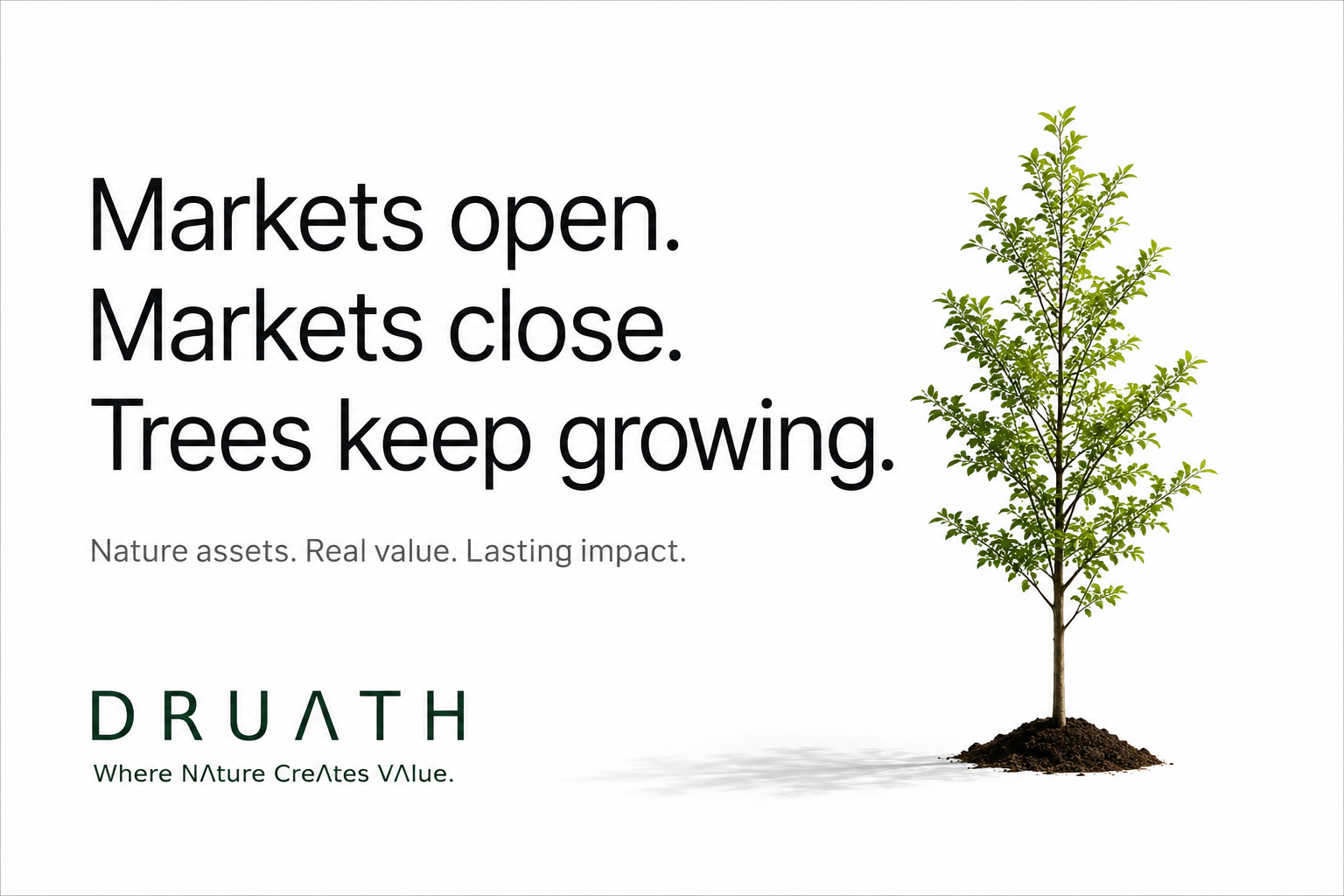
Its biological inventory can continue growing regardless of what financial markets are doing.
Trees don't check the stock market before growing.
Every growing season adds biological volume, develops the woodland structure and advances the maturity of the asset.
That doesn't remove forestry risk. Storms, disease, fire, regulation and changing market conditions all need to be considered.
But it gives woodland a fundamentally different investment profile from purely financial assets.
5. Timber and Sustainable Forestry
Not every Druath woodland needs to follow the same model.
Some land may be suited to permanent native woodland.
Other sites may lend themselves to productive broadleaf forestry, mixed woodland or Continuous Cover Forestry, where woodland is managed without conventional large-scale clear-felling.
Ireland's current Woodland Improvement Scheme actively supports closer-to-nature forestry and Continuous Cover Forestry, including financial support for qualifying interventions.
That gives Druath the flexibility to think about land individually rather than applying one forestry model everywhere.
The right woodland on the right land.
6. Carbon
Trees absorb carbon dioxide as they grow and store carbon within their biomass and surrounding woodland ecosystem.
That creates another potentially valuable characteristic of woodland ownership.
As high-quality carbon measurement and verification systems develop, appropriately structured woodland projects may create additional environmental value associated with carbon sequestration.
We believe this area has significant long-term potential.
However, Druath does not believe in building an investment proposition around speculative future carbon prices.
Carbon should represent potential additional value — not the only reason an investment works.
7. Biodiversity and Natural Capital
Perhaps the most interesting development is one that traditional investment models have historically struggled to value:
nature itself.
A woodland can provide habitat.
It can support insects, birds and mammals.
It can improve soil.
It can protect water.
It can sequester carbon.
It can improve landscape resilience.
Ireland's Native Woodland Conservation Scheme explicitly recognises these ecosystem services, including biodiversity, soil protection, water quality and climate benefits.
These benefits increasingly fall under the concept of natural capital.
As businesses and governments become more focused on biodiversity and nature restoration, we believe land capable of delivering measurable ecological outcomes may become increasingly strategically important.
8. Connecting Companies and Consumers With Nature
Druath also sees another opportunity.
Traditionally, forestry investors waited for forestry to generate value.
We believe technology can allow woodland assets to interact with people and companies much earlier.
Individual trees can be funded.
Companies can support woodland creation.
People can become connected to individual woodland projects.
Digital platforms can potentially turn what was once an inaccessible forestry asset into something that thousands of people can interact with.
This creates the potential for additional commercial income from the woodland while retaining the underlying land and nature asset.
A Different Way of Looking at Returns
This is why Druath doesn't look at woodland investment through a single lens.
Potential value can come from:
Land ownership
Forestry grants
Annual premiums
Biological growth
Forestry income
Carbon potential
Biodiversity and natural capital
Commercial participation in the woodland
Potential long-term land appreciation
That is a very different proposition from simply planting trees and waiting several decades for timber.
What Could the Numbers Look Like?
Independent analysis from Teagasc demonstrates that forestry can produce meaningful long-term economic returns.
Its 2026 forestry outlook calculated indicative Annual Equivalent Values of approximately €560 per hectare per year for a broadleaf forestry scenario (FT7) and up to €710 per hectare per year for an FT12 mixed high-forest scenario, based on the particular assumptions used in its forestry investment model.
These figures should not be interpreted as guaranteed Druath returns.
Every woodland is different.
Land acquisition cost, species, grants, forestry type, management costs, financing, premiums and eventual exit value can materially change the economics.
But they demonstrate an important point:
Forestry is capable of being considered as an economic land use as well as an environmental one.
Why Druath?
Druath was created around a simple idea.
What if restoring nature could also make financial sense?
Rather than seeing nature restoration solely as a cost, we look for land where capital and nature can work together.
Our model focuses on:
Identifying suitable land
Acquiring real underlying assets
Establishing appropriate woodland
Accessing available forestry supports
Creating recurring income where possible
Developing additional commercial value from the woodland
Managing the asset for the long term
Creating measurable environmental impact
We call these nature assets.
Investing for Decades, Not Quarters
Woodland investment isn't for everyone.
Trees grow slowly.
Land is illiquid.
Government policy can change.
Forestry carries environmental and operational risks.
And meaningful ecological restoration takes time.
But that long-term horizon can also be part of its attraction.
Markets can move in seconds.
Companies can disappear.
Technology can become obsolete.
Land remains land.
And a well-managed woodland has the potential to become more established, more ecologically valuable and more economically interesting as it matures.
Where Nature Creates Value
We believe the next generation of investors will increasingly ask two questions about their capital:
What return can it generate?
And:
What does it create?
With nature assets, those two questions don't necessarily have to compete.
Capital can acquire land.
Land can become woodland.
Woodland can generate income.
Trees can capture carbon.
Habitats can return.
Biodiversity can increase.
And an asset that begins as a field can potentially become more valuable environmentally and economically with every passing decade.
That is the Druath philosophy.
Where nature creates value.
Discover Nature Asset Opportunities in Ireland
Druath acquires and develops land for long-term woodland and nature asset projects in Ireland.
If you're interested in investing in Irish woodland, forestry, natural capital or nature-backed real assets, explore Druath.com or contact us to discuss future opportunities.
Investment values, grants, premiums and potential returns vary by project and eligibility. Forestry and land investments involve risk, can be illiquid and should be considered long-term investments. Nothing in this article constitutes financial, tax or investment advice.