Forests as Critical Infrastructure: The Long-Term Value of Native Woodland Ownership
Have you ever considered forests critical infrastructure?
We recognise the importance of roads, electricity networks and water systems. We invest in them because our communities and economies depend on the services they provide.
Healthy woodlands deserve the same long-term thinking.
They store carbon, support biodiversity, protect soils and help regulate water. They are living assets that provide essential services, often over generations. The European Environment Agency recognises these contributions while highlighting the pressures facing forest ecosystems.
At Druath, we believe this creates a compelling reason to think differently about native woodland ownership in Ireland: as ownership of natural infrastructure whose importance could grow over time.
Why native woodlands are natural infrastructure
Infrastructure provides the foundations on which other activity depends. Nature does this every day.
A healthy woodland supports a network of relationships between trees, soils, water, fungi, insects, birds and other wildlife. Its contribution extends beyond the boundary of the land.
That is why creating woodland requires a perspective measured in decades. The natural infrastructure we need in the future must be established and cared for today.
For Druath, scaling natural assets means acquiring suitable land, creating native woodlands and supporting their long-term stewardship.
Woodland ownership starts with a tangible asset
At the centre of the proposition is land.
Ownership provides a tangible foundation for a long-term strategy. On suitable sites, woodland creation can add further layers of ecological and potential commercial value.
Those layers may include eligible forestry premiums, tree sponsorship arrangements and opportunities connected with independently verified environmental outcomes.
Ireland’s Afforestation Scheme supports woodland establishment through grants and annual premiums, subject to eligibility, approval and ongoing management requirements. These supports can contribute to a woodland’s financial foundations during its establishment and development.
At Druath, shareholders own an interest in the company that holds the woodland assets. This is distinct from holding direct title to an individual plot of land.
Can woodland assets provide stability and grow in value?
Our ambition is to build enduring value through land ownership, responsible management and the development of healthy native woodlands.
There is a reasonable investment thesis behind that ambition: land is finite, established woodland takes time to create, and functioning ecosystems provide services that society needs.
However, a tangible asset does not automatically have a stable market price.
Woodland valuations depend on location, access, condition, management obligations, income prospects and buyer demand. Land and company shares can also take time to sell.
We therefore see stability as something to work towards through careful acquisition, manageable costs and responsible stewardship. Capital appreciation remains a potential outcome, rather than an assured result.
Why the climate crisis could strengthen the case for natural assets
As climate pressures intensify, our view is that the strategic importance of healthy woodlands will become increasingly apparent.
Businesses, communities and governments need functioning ecosystems. Greater recognition of that dependence could support demand for well-managed natural assets and the environmental services they provide.
That is central to Druath’s long-term thesis.
But growing environmental importance does not automatically translate into higher financial valuations. That connection depends on credible measurement, commercial agreements, policy and markets that recognise and pay for environmental outcomes.
Climate change also threatens woodlands themselves. Drought, storms, fire, pests and disease can damage forests and affect their economic viability. Site selection, suitable species and adaptive management therefore matter throughout the life of an asset.
Building value requires more than planting trees
Acquiring land and planting trees are the beginning of the work.
Long-term value depends on establishing the right woodland in the right place, securing the necessary permissions, managing establishment and monitoring how the site develops.
Working alongside Cloudforests, Druath’s ambition is to connect woodland asset ownership with practical woodland creation experience and engagement with businesses and communities.
Our focus is on the years beyond planting: healthier habitats, developing woodlands and a credible understanding of environmental progress.
Potential future income from carbon or biodiversity markets must be assessed separately. It depends on eligibility, verification, ownership of the relevant rights and actual market demand.
A longer-term role for native woodland investment in Ireland
We believe native woodland ownership deserves consideration within a broader conversation about business resilience, environmental strategy and long-term investment.
The opportunity is to help finance natural infrastructure while owning an interest in the assets being developed.
Financial value and environmental value are connected, but they are not interchangeable. Druath’s ambition is to build both through patient capital, practical expertise and responsible stewardship.
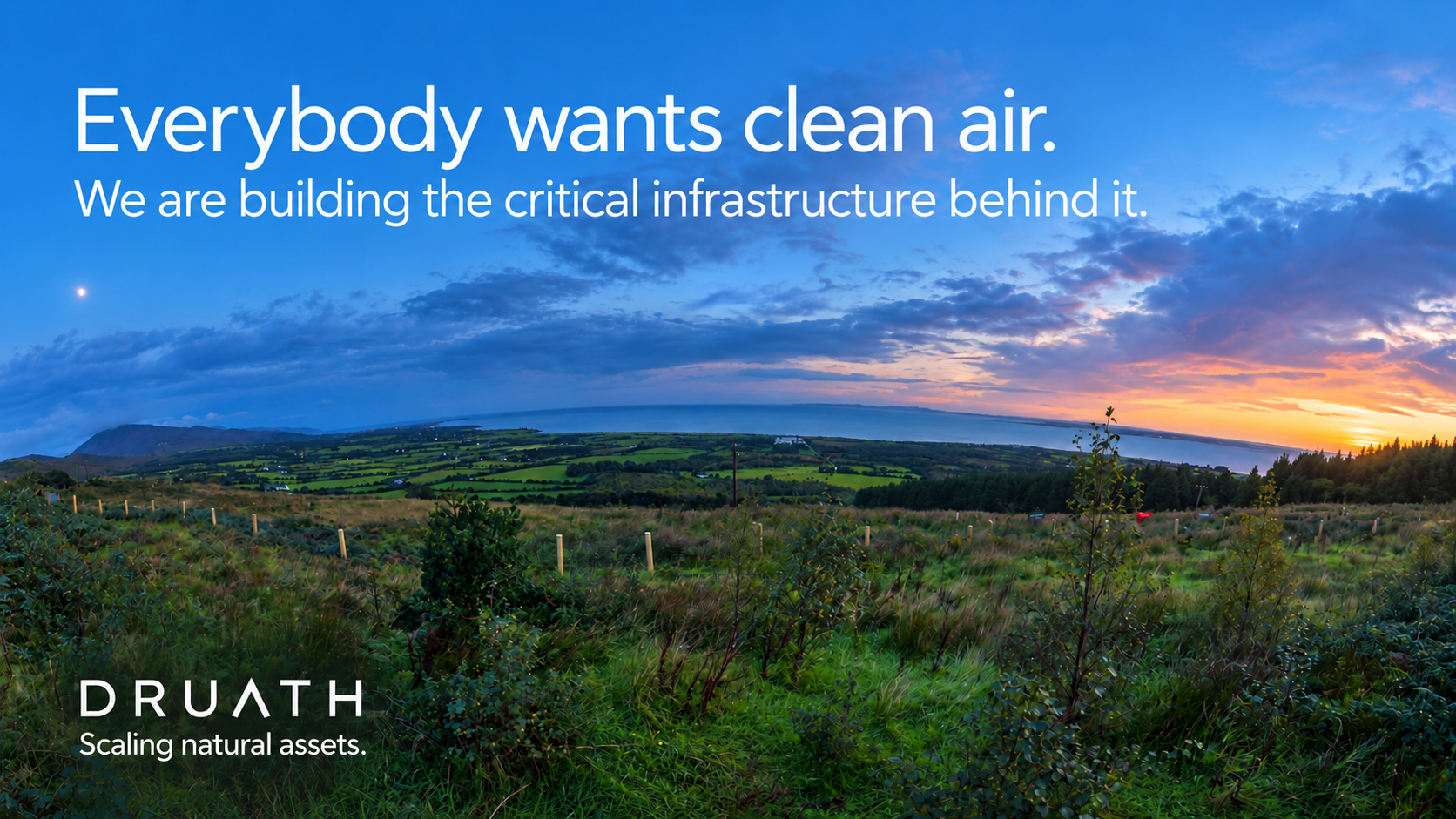
Everybody wants clean air.
We’re building the natural infrastructure behind it.
To learn more about Druath’s approach to native woodland ownership in Ireland, get in touch and explore our vision for scaling natural assets.
Druath | Scaling natural assets.
Investment involves risk. Asset values and income can fall as well as rise, and capital is at risk. Woodland investments require a long-term perspective and may be difficult to sell.